
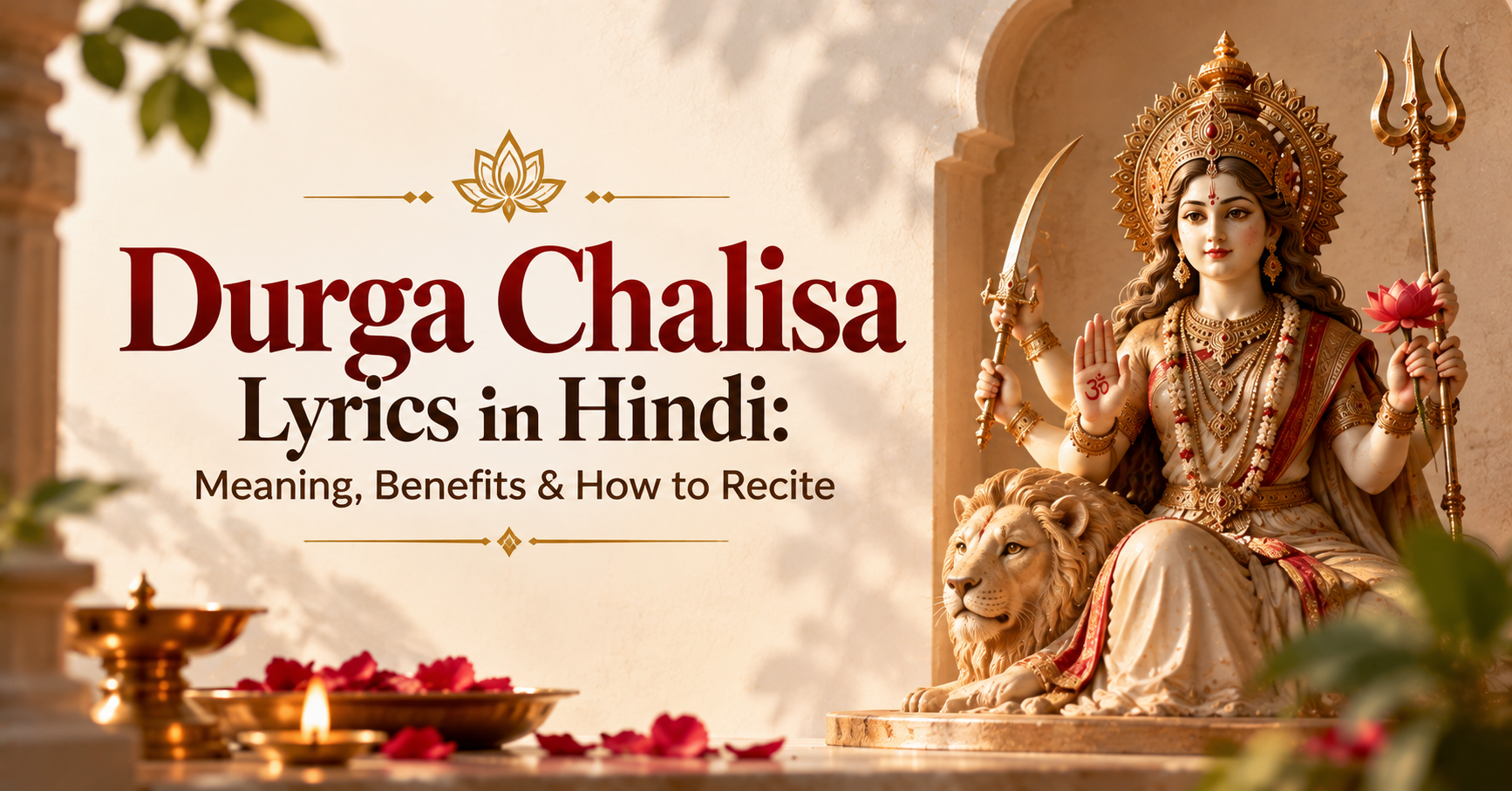
The Durga Chalisa is a devotional hymn dedicated to Maa Durga and her divine forms. The word Chalisa means forty, referring to the 40 verses of the prayer. Devotees recite the Durga Chalisa to express devotion and seek Maa Durga’s blessings, strength and protection.
The prayer is especially popular during Navratri, when devotees dedicate time to worshipping Maa Durga. If you are looking for Durga Chalisa lyrics in Hindi, its meaning, benefits, or the right way to perform the Durga Chalisa paath, this guide covers the essentials.
What Is Durga Chalisa?
The Durga Chalisa is a 40-verse devotional hymn that praises Maa Durga, her different forms and her victories. It is traditionally recited as a form of devotion and prayer, particularly during Navratri.
The word Chalisa literally refers to forty. The prayer describes Maa Durga as a powerful and compassionate divine presence and celebrates her role as a protector of her devotees.
For many devotees, reading Durga Chalisa lyrics is part of their regular prayer routine, while others recite it specifically during Navratri or other occasions dedicated to Maa Durga.
Who Wrote Durga Chalisa?
The Durga Chalisa is traditionally attributed to poet Devidas, whose name appears in the closing verse. However, the historical authorship is not firmly established, so it is more appropriate to describe it as traditionally attributed to Devidas rather than definitively written by him.
How Many Verses Does Durga Chalisa Have?
The Durga Chalisa contains 40 verses, which gives the prayer its name. Chalisa means forty.
The main prayer consists of these devotional verses praising Maa Durga and her various forms. Some versions may present the concluding lines separately, but the Chalisa itself refers to its 40-verse structure.
Durga Chalisa Lyrics in Hindi
If you are searching for Durga Chalisa written in Hindi, the traditional prayer is presented below. Reading the lyrics in their original Hindi form can make it easier for devotees to follow their regular Durga Chalisa paath.
॥ श्री दुर्गा चालीसा ॥
नमो नमो दुर्गे सुख करनी।
नमो नमो अम्बे दुःख हरनी॥
निरंकार है ज्योति तुम्हारी।
तिहुँ लोक फैली उजियारी॥
शशि ललाट मुख महाविशाला।
नेत्र लाल भृकुटि विकराला॥
रूप मातु को अधिक सुहावे।
दरश करत जन अति सुख पावे॥
तुम संसार शक्ति लै कीना।
पालन हेतु अन्न धन दीना॥
अन्नपूर्णा हुई जग पाला।
तुम ही आदि सुन्दरी बाला॥
प्रलयकाल सब नाशन हारी।
तुम गौरी शिवशंकर प्यारी॥
शिव योगी तुम्हरे गुण गावें।
ब्रह्मा विष्णु तुम्हें नित ध्यावें॥
रूप सरस्वती को तुम धारा।
दे सुबुद्धि ऋषि मुनिन उबारा॥
धरा रूप सीता तुम माहीं।
रावण संहार कियो रघुराई॥
कृष्ण रूप धरि कंस पछारा।
राधा संग प्रेम बढ़ाया॥
हिंगलाज में तुम्हीं भवानी।
महिमा अमित न जाय बखानी॥
मातंगी धूमावती माता।
भुवनेश्वरी बगलामुखी दाता॥
श्री भैरवी तारा जग तारा।
छिन्नमस्ता भव दुःख हारा॥
केहरि वाहन सोह भवानी।
अष्ट भुजा धारी बलवानी॥
कुमकुम केसर रंग सुहाए।
सिंह सवारी मन को भाए॥
कटि करधनी मधुर धुन बाजे।
नूपुर चरणों में मन राजे॥
कर में खड्ग त्रिशूल सुहावै।
घंटा धुनि से असुर डरावै॥
शस्त्र अस्त्र धारण कर माता।
भक्तन की तुम सदा प्रतिपाता॥
नगरकोट में तुम्हीं विराजत।
तुम्हीं जगत में शोभा पावत॥
ज्वाला जी में ज्योति तुम्हारी।
तुम्हीं सदा हो संकट हारी॥
दुष्टों का तुम नाशन करती।
भक्तों की तुम विपदा हरती॥
सुमिरत नाम तुम्हारा माता।
भय संकट सब दूर भगाता॥
जो कोई तुम्हें ध्यावे।
मनवांछित फल वह पावे॥
दुर्गम काज जगत के जेते।
सुगम अनुग्रह तुम्हरे तेते॥
तुम्हरे नाम अनेक भवानी।
करहु कृपा जगदम्ब भवानी॥
दुर्गा चालीसा जो कोई गावै।
सब सुख भोग परमपद पावै॥
देवीदास शरण निज जानी।
करहु कृपा जगदम्ब भवानी॥
Note: Different versions of devotional texts can have minor differences in spelling, wording and presentation.
Durga Chalisa in English (Roman Script)
For readers who are more comfortable with English letters, Durga Chalisa in English can be followed using Roman transliteration. This can be particularly helpful for beginners who are learning the pronunciation.
For example:
Namo Namo Durge Sukh Karni
Namo Namo Ambe Dukh Harni
Nirankar Hai Jyoti Tumhari
Tihun Lok Phaili Ujiyari
Shashi Lalat Mukh Mahavishala
Netra Lal Bhrikuti Vikarala
Using a Roman-script version alongside the Hindi lyrics can help beginners gradually become familiar with the traditional pronunciation.
What Is the Meaning of Durga Chalisa?
The Durga Chalisa praises Maa Durga and describes her divine power, different forms and role as a protector.
The opening verses offer salutations to Maa Durga and describe her as one who brings happiness and removes sorrow. The prayer then describes her divine form and her role in sustaining the world.
Several verses refer to different manifestations associated with the Divine Mother. The Chalisa also describes Maa Durga’s strength and her victories over evil, presenting her as a source of courage and protection for devotees.
At its core, the prayer is an expression of devotion and surrender. Understanding the Durga Chalisa meaning can help devotees connect more deeply with the words they recite instead of simply reading the verses.
What Are the Benefits of Reading Durga Chalisa?
Devotional traditions associate reading the Durga Chalisa with several spiritual benefits. These are matters of faith and should not be understood as guaranteed outcomes.
1. A sense of courage
Maa Durga is traditionally associated with strength and the ability to overcome adversity. Reciting her Chalisa can be a way for devotees to seek inner courage.
2. Freedom from fear
The prayer describes Maa Durga as a protector who removes difficulties and fear. Devotees may turn to the Chalisa when looking for reassurance and spiritual strength.
3. Mental calm
Regular prayer can create a quiet moment in the day for reflection and devotion. Reciting the Chalisa with attention may help devotees feel more centred.
4. Deeper devotion
Learning and regularly reciting the verses can help devotees become more familiar with Maa Durga’s different forms and qualities.
5. Seeking Maa Durga’s blessings
The Durga Chalisa is ultimately a devotional prayer. Many devotees recite it while seeking Maa Durga’s blessings, grace and protection.
How to Recite Durga Chalisa at Home
There is no need for a complicated ritual to begin reading the Durga Chalisa at home. A simple and sincere prayer routine can be enough.
You can follow these steps:
- Choose a clean and quiet place for prayer.
- Place an image or idol of Maa Durga if that is part of your usual worship.
- Light a diya if you normally include one in your prayer.
- Sit comfortably and take a moment to settle your mind.
- Read the Durga Chalisa lyrics in Hindi slowly.
- Beginners can use a Roman-script version to follow pronunciation.
- Focus on the meaning of the verses as you read.
- End the paath with a personal prayer to Maa Durga.
The goal is not simply to complete the verses quickly. Reading with attention and devotion can make the practice more meaningful.
Best Time to Read Durga Chalisa
The Durga Chalisa paath can be performed according to your daily routine. Early morning, particularly Brahma Muhurta, around 4 AM to 6 AM, is traditionally considered an auspicious time for prayer. Evening is another suitable time.
Navratri is an especially significant period for Maa Durga worship, and many devotees include the Chalisa in their daily prayers during these nine days. Fridays are also traditionally considered auspicious for Devi worship.
There is no need to choose a time that makes regular prayer difficult. A consistent time when you can sit peacefully and recite the Chalisa is a practical approach.
How Many Times Should You Read It During Navratri?
There is no fixed rule for the number of times the Durga Chalisa must be recited.
For regular worship, once daily is enough. During Navratri, some devotees recite it 3, 9 or 11 times, while 7 or 11 repetitions may be followed on special days depending on individual or family tradition.
The number of repetitions is a matter of devotional practice, not a guarantee of a particular result.
Durga Chalisa vs Durga Aarti: What Is the Difference?
The Durga Chalisa and Durga Aarti are two different forms of devotional prayer.
The Durga Chalisa is a 40-verse hymn that praises Maa Durga, her forms, qualities and divine acts. It is generally read or recited as a paath.
A Durga Aarti is a shorter prayer traditionally sung during the aarti ritual, often as part of a puja.
Many families include both in their worship. A devotee may recite the Durga Chalisa and then conclude the puja with Durga Aarti.
Listen to Durga Chalisa – Soulful Bhajans Video
Reading the Durga Chalisa lyrics can help you become familiar with the prayer, while listening to a devotional rendition can make it easier to follow the pronunciation and rhythm.
You can listen to the Soulful Bhajans Durga Chalisa video while reading along, during your prayer routine or while learning the verses.
For more devotional music, explore the devotional videos collection from Soulful Bhajans.
Frequently Asked Questions
How many times should Durga Chalisa be read?
The Durga Chalisa can be read once daily as part of regular worship. During Navratri, some devotees recite it 3, 9 or 11 times, while 7 or 11 repetitions may be followed on special days. There is no universally fixed number, so devotees can follow their family tradition or personal practice.
What are the benefits of reading Durga Chalisa?
Devotees traditionally associate the Durga Chalisa with courage, protection, peace of mind and Maa Durga’s blessings. These benefits are matters of devotional belief rather than guaranteed outcomes. The prayer can also provide a regular moment for reflection, remembrance and deeper devotion.
When is the best time to recite Durga Chalisa?
Early morning, particularly Brahma Muhurta between approximately 4 AM and 6 AM, is traditionally considered an auspicious time to recite the Durga Chalisa. Evening is also suitable. Navratri and Fridays are particularly associated with Maa Durga and Devi worship.
Who wrote the Durga Chalisa?
The Durga Chalisa is traditionally attributed to Devidas, whose name appears in the closing verse. However, the historical authorship is not firmly established. Therefore, it is more accurate to say that the Chalisa is traditionally attributed to Devidas rather than definitively identifying him as its author.
How many verses does Durga Chalisa have?
The Durga Chalisa has 40 verses, which is why it is called a Chalisa. The word Chalisa means forty. Different editions may present the concluding lines separately, but the main Chalisa follows the traditional 40-verse structure.
Is Durga Chalisa different from Durga Aarti?
Yes. Durga Chalisa is a 40-verse devotional hymn, while Durga Aarti is a shorter prayer traditionally sung as part of a puja or aarti ritual. Many devotees choose to recite the Chalisa and then perform Durga Aarti as part of the same worship.
Can beginners read Durga Chalisa every day?
Yes. Beginners can read the Durga Chalisa every day. There is no need to memorise the prayer before starting. You can follow the Durga Chalisa lyrics in Hindi, use a Roman-script version for pronunciation and gradually become familiar with the verses through regular reading.
What is the best Durga Chalisa for Navratri?
The traditional Durga Chalisa can be recited daily during Navratri as part of devotional practice. You can read the Hindi lyrics directly or follow a devotional rendition. For an easier listening experience, you can also listen to the Soulful Bhajans Durga Chalisa video.
Explore More Devotional Content
If you are looking for more devotional content during Navratri, explore Navratri bhajans lyrics and learn more about Navratri significance and traditions.
You can also explore Hanuman Chalisa lyrics and meaning for another popular Chalisa, or read more Hindi bhajan lyrics and their meaning.
For more about devotional listening, read about the benefits of devotional listening or explore the Hindu deities category.
The Durga Chalisa can be a simple part of a regular devotional routine—whether you recite it every day, during Navratri or whenever you wish to spend a few moments in prayer and remembrance of Maa Durga.