
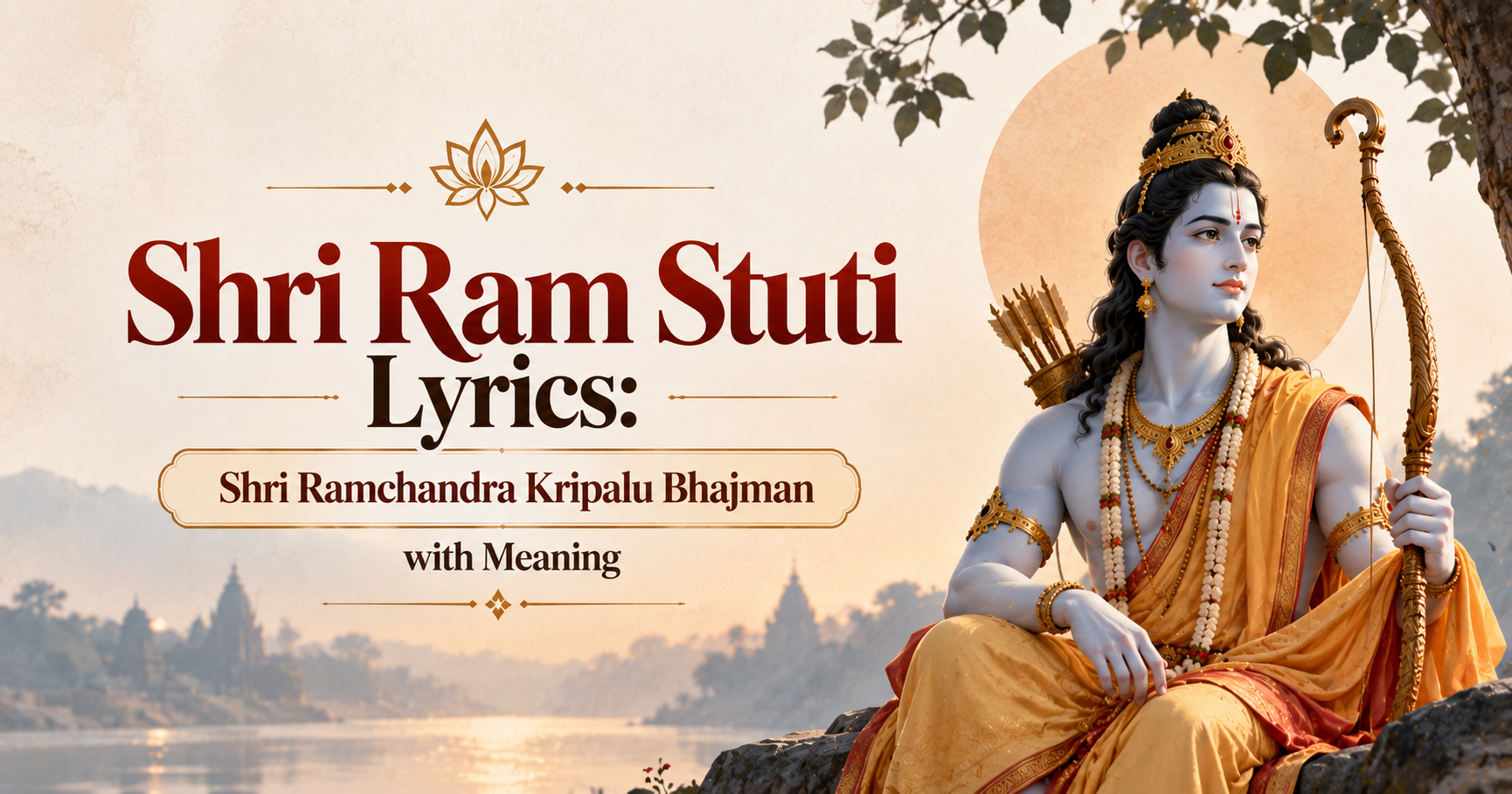
Ram Stuti is a devotional hymn dedicated to Lord Rama, praising his compassion, beauty, virtues and divine nature. One of the best-known Ram Stutis begins with the words “Shri Ramchandra Kripalu Bhajman”, making the hymn widely searched by devotees looking for Shri Ram Stuti lyrics and its meaning.
Traditionally associated with Goswami Tulsidas, the prayer is recited in homes, temples and satsang. It is especially relevant around Dussehra and Diwali, when devotees remember Lord Rama’s victory over Ravana and his return to Ayodhya.
If you are looking for Shree Ram Stuti lyrics, the meaning of Shree Ramchandra Kripalu Bhajman, the benefits of reciting Ram Stuti or how to include it in your daily prayer, this guide covers the complete hymn in Hindi and Roman script.
What Is Shri Ram Stuti?
Shri Ram Stuti is a devotional hymn praising Lord Rama’s compassion, beauty and divine qualities. It opens with “Shri Ramchandra Kripalu Bhajman” and is traditionally sung or recited in temples, homes and satsang. The prayer expresses devotion to Rama while remembering his compassionate, courageous and righteous nature.
The prayer is also commonly referred to as Ram Ji Ki Stuti. It is particularly known for its descriptions of Lord Rama’s appearance, character and divine qualities.
The opening words address the devotee’s own mind, encouraging it to remember and worship Lord Rama.
Who Wrote Shri Ramchandra Kripalu Bhajman?
Shri Ramchandra Kripalu Bhajman is traditionally attributed to Goswami Tulsidas, the 16th-century saint-poet associated with major devotional works dedicated to Lord Rama. The hymn is linked to his Vinaya Patrika, a collection of devotional prayers expressing humility, surrender and devotion.
Tulsidas’s devotional writings continue to be an important part of North Indian bhakti traditions.
Why Is It Popular Around Dussehra and Diwali?
Lord Rama has a strong connection with both Dussehra and Diwali. Dussehra, also known as Vijayadashami, is associated with Rama’s victory over Ravana, while Diwali is traditionally associated with Rama’s return to Ayodhya after his exile.
As a result, Ram prayers, Ram Stuti and Ram bhajans often become part of devotional listening and worship during this period.
You can learn more about the festival through the Diwali festival of lights.
Shri Ram Stuti Lyrics in Hindi
If you are searching for Shri Ram Stuti lyrics, Shree Ram Stuti lyrics or the Shri Ramchandra Kripalu Bhajman lyrics, the traditional hymn is given below.
श्री रामचन्द्र कृपालु भजमन
श्री रामचन्द्र कृपालु भजमन हरण भवभय दारुणम्।
नवकंज लोचन कंज मुख कर कंज पद कंजारुणम्॥
कन्दर्प अगणित अमित छवि नव नील नीरद सुन्दरम्।
पटपीत मानहुँ तड़ित रुचि शुचि नौमि जनक सुतावरम्॥
भजु दीनबन्धु दिनेश दानव दैत्यवंश निकन्दनम्।
रघुनन्द आनन्दकन्द कोशलचन्द दशरथ नन्दनम्॥
शिर मुकुट कुंडल तिलक चारु उदारु अंग विभूषणम्।
आजानुभुज शर चाप धर संग्राम जित खरदूषणम्॥
इति वदति तुलसीदास शंकर शेष मुनि मन रंजनम्।
मम हृदय कंज निवास कुरु कामादि खलदल गंजनम्॥
मनु जाहिं राचेउ मिलिहि सो बरु सहज सुंदर साँवरो।
करुना निधान सुजान सीलु सनेहु जानत रावरो॥
एहि भाँति गौरी असीस सुनि सिय सहित हियँ हरषीं अली।
तुलसी भवानिहि पूजि पुनि पुनि मुदित मन मंदिर चली॥
Note: Traditional devotional texts may have minor variations in spelling, punctuation or presentation across editions.
Shri Ram Stuti Lyrics in English (Roman Script)
For readers who are more comfortable with English letters, Shri Ram Stuti lyrics in English can be followed through Roman transliteration.
Shri Ramchandra Kripalu Bhajman
Haran Bhav Bhay Darunam
Nav Kanj Lochan Kanj Mukh
Kar Kanj Pad Kanjarunam
Kandarp Aganit Amit Chhavi
Nav Neel Neerad Sundaram
Pat Peet Manahu Tadit Ruchi
Shuchi Naumi Janak Sutavaram
Bhaju Deen Bandhu Dinesh
Danav Daitya Vansh Nikandanam
Raghunand Anand Kand
Kaushal Chand Dashrath Nandanam
Shir Mukut Kundal Tilak Charu
Udar Ang Vibhushanam
Aajaanubhuj Shar Chap Dhar
Sangram Jit Khar Dushanam
A Roman-script version can be useful for beginners who want to follow the pronunciation while learning the original Hindi text.
Shri Ram Stuti Meaning, Verse by Verse
Understanding the Shree Ramchandra Kripalu Bhajman meaning can make the recitation more meaningful. The hymn praises Lord Rama’s appearance, compassion, courage and righteous character.
“Shri Ramchandra Kripalu Bhajman”
The opening line means, in essence, “O mind, worship compassionate Shri Ramchandra.” It presents Rama as compassionate and as one who removes the fear associated with worldly existence.
The line therefore begins the hymn with a direct call to remember and worship Lord Rama.
“Nav Kanj Lochan Kanj Mukh…”
This verse describes Lord Rama through the imagery of the lotus. His eyes, face, hands and feet are compared with lotus flowers.
The imagery highlights his beauty, grace and divine nature.
“Kandarp Aganit Amit Chhavi…”
This verse describes Rama’s incomparable beauty and radiant appearance. It also refers to his yellow garments and identifies him as the husband of Sita, the daughter of King Janaka.
“Bhaju Deen Bandhu Dinesh…”
Rama is praised as a friend of those who are in need and as a source of light. The verse also remembers him as the destroyer of evil forces and the son of Dasharatha.
“Raghunand Anand Kand…”
Here, Rama is described as the joy of the Raghu dynasty and a source of happiness. The verse also identifies him as the son of Dasharatha and prince of Ayodhya.
“Shir Mukut Kundal…”
This verse describes Rama’s appearance, including his crown, earrings, tilak and ornaments. It also portrays him carrying his bow and arrows and recalls his victory over Khara and Dushana.
“Iti Vadati Tulsidas…”
In this section, Tulsidas expresses his devotion directly. He asks Lord Rama to reside in his heart and remove negative qualities and distractions.
The verse turns the description of Rama into a personal prayer for inner purification.
The Closing Verses
The final verses bring in Sita and her devotion to Rama. They describe the blessings associated with the divine story of Rama and Sita and conclude the hymn with devotion and prayer.
Benefits of Reciting Shri Ram Stuti
Devotees traditionally associate Ram Stuti with spiritual and emotional benefits. These should be understood as devotional beliefs rather than guaranteed outcomes.
- Calm mind: Regular prayer can provide a quiet space for reflection and remembrance.
- Less fear: The opening verse describes Rama as one who removes the fear associated with worldly existence.
- Steady devotion: Regular recitation can help create a consistent devotional practice.
- Courage: Remembering Rama’s qualities can inspire devotees to approach difficulties with greater inner strength.
- Righteousness: The prayer celebrates qualities such as compassion, courage, discipline and devotion.
How to Recite Ram Stuti at Home
You do not need an elaborate ritual to recite a full Ram Stuti at home. A simple and sincere prayer routine is enough.
- Sit calmly in a clean, quiet space.
- Light a diya if it is part of your regular prayer practice.
- Read the Shri Ram Stuti lyrics slowly and attentively.
- Read along with the meaning if you are unfamiliar with the language.
- End with a short personal prayer or silent remembrance of Lord Rama.
You do not need to know Sanskrit to begin. A Hindi or Roman-script version can help with pronunciation and understanding.
Some devotees follow a tradition of reciting Ram Stuti 11 times over 11 days. This is a devotional tradition, not a universal rule.
Ram Stuti vs Ram Bhajan vs Hanuman Chalisa
These three forms of devotional expression are related but have different structures and purposes.
Ram Stuti praises Lord Rama and his divine qualities. Ram Bhajan is a devotional song centred on Lord Rama and can vary in structure and style.
Hanuman Chalisa is a 40-verse devotional hymn dedicated to Lord Hanuman. Both Ram Stuti and Hanuman Chalisa are associated with the devotional tradition of Tulsidas, but they focus on different deities.
For more, explore Hanuman Chalisa or read Hanuman Chalisa lyrics and meaning.
Listen to Ram Bhajans – Soulful Bhajans Video
If you are looking for a devotional rendition of Ram Stuti, you can listen to the Soulful Bhajans Ram upload while following the lyrics and meaning.
The video can also be used as part of a daily devotional routine or while learning the pronunciation of Shri Ramchandra Kripalu Bhajman.
For more devotional listening, explore popular Hindi bhajans, discover more devotional bhajans or browse the devotional videos collection.
Frequently Asked Questions
Who Wrote Shri Ram Stuti?
Shri Ram Stuti is traditionally attributed to Goswami Tulsidas, the 16th-century saint-poet associated with devotional works dedicated to Lord Rama. The hymn beginning “Shri Ramchandra Kripalu Bhajman” is linked to his Vinaya Patrika, a collection of devotional prayers centred on humility, surrender and devotion.
What Is the Meaning of Shri Ramchandra Kripalu Bhajman?
“Shri Ramchandra Kripalu Bhajman” means, in essence, “O mind, worship compassionate Shri Ramchandra.” The line presents Lord Rama as compassionate and as one who removes the fear associated with worldly existence. It establishes the prayer’s central theme of devotion, remembrance and surrender.
What Are the Benefits of Reciting Ram Stuti?
Devotees traditionally associate Ram Stuti with peace of mind, less fear, steady devotion, courage and a stronger connection with righteous values. These are matters of devotional belief rather than guaranteed outcomes. Regular recitation can also create a dedicated moment for prayer, reflection and remembrance of Lord Rama.
Can I Chant Ram Stuti Without Knowing Sanskrit?
Yes, you can chant Ram Stuti without knowing Sanskrit. The hymn is traditionally associated with Awadhi and Sanskrit devotional language, and beginners can use Hindi explanations or Roman-script lyrics to understand the meaning and pronunciation. You do not need to memorise the prayer before beginning a regular devotional practice.
What Is the Difference Between Ram Stuti and Hanuman Chalisa?
Ram Stuti praises Lord Rama, while Hanuman Chalisa praises Lord Hanuman. They also differ in structure and subject matter. Both are associated with the devotional tradition of Tulsidas, but Ram Stuti focuses on Rama’s compassion and virtues, while Hanuman Chalisa celebrates Hanuman’s devotion, strength and qualities.
How Many Times Should Ram Stuti Be Recited?
There is no universally fixed number of repetitions for Ram Stuti. Some devotees follow a tradition of reciting it 11 times over 11 days, but this is a devotional practice rather than a compulsory rule. A single, attentive recitation can also be included in a daily prayer routine.
What Is the Best Ram Stuti to Listen To?
There are several devotional renditions of Ram Stuti available, and the Soulful Bhajans Ram upload can be used to follow the prayer while listening. You can read the lyrics alongside the video or simply use it as part of your devotional listening routine without relying on a particular commercial singer’s version.
Is There a Shri Ram Stuti PDF?
If you are searching for a Shri Ram Stuti PDF, the complete Hindi lyrics and Roman-script version above can be used as a reference. A downloadable PDF should only be linked if an official Soulful Bhajans PDF is available.
What Is Ram Ji Ki Stuti?
Ram Ji Ki Stuti refers to a devotional prayer or hymn praising Lord Rama. Shri Ramchandra Kripalu Bhajman is a well-known example. It praises Rama’s compassion, beauty, virtues and divine qualities while encouraging the mind to remember and worship him.
What Are the Shri Ramchandra Kripalu Bhajman Lyrics?
The Shri Ramchandra Kripalu Bhajman lyrics are the verses of the devotional hymn beginning “Shri Ramchandra Kripalu Bhajman.” The complete Hindi text is provided above, along with a Roman-script version to help readers follow the pronunciation.
Are Nitin Mukesh Shri Ram Stuti Lyrics Different?
Searches for Nitin Mukesh Shri Ram Stuti lyrics generally relate to a particular recorded rendition rather than a different devotional text. This article focuses on the traditional Shri Ramchandra Kripalu Bhajman text and does not reproduce or attribute lyrics to a commercial singer’s version.
Explore More Devotional Content
The devotional tradition surrounding Lord Rama extends beyond Ram Stuti. You can explore the Hanuman Chalisa and its lyrics and meaning for another important devotional text associated with Tulsidas.
During Diwali, learn more about the Diwali festival of lights and discover other popular Hindi bhajans.
You can also explore more devotional bhajans, read about the Durga Chalisa, or browse the complete devotional videos collection.
Whether you recite Shri Ramchandra Kripalu Bhajman during Dussehra, Diwali or as part of your daily prayer, Shri Ram Stuti offers a devotional way to remember Lord Rama’s compassion, courage and righteous nature.