
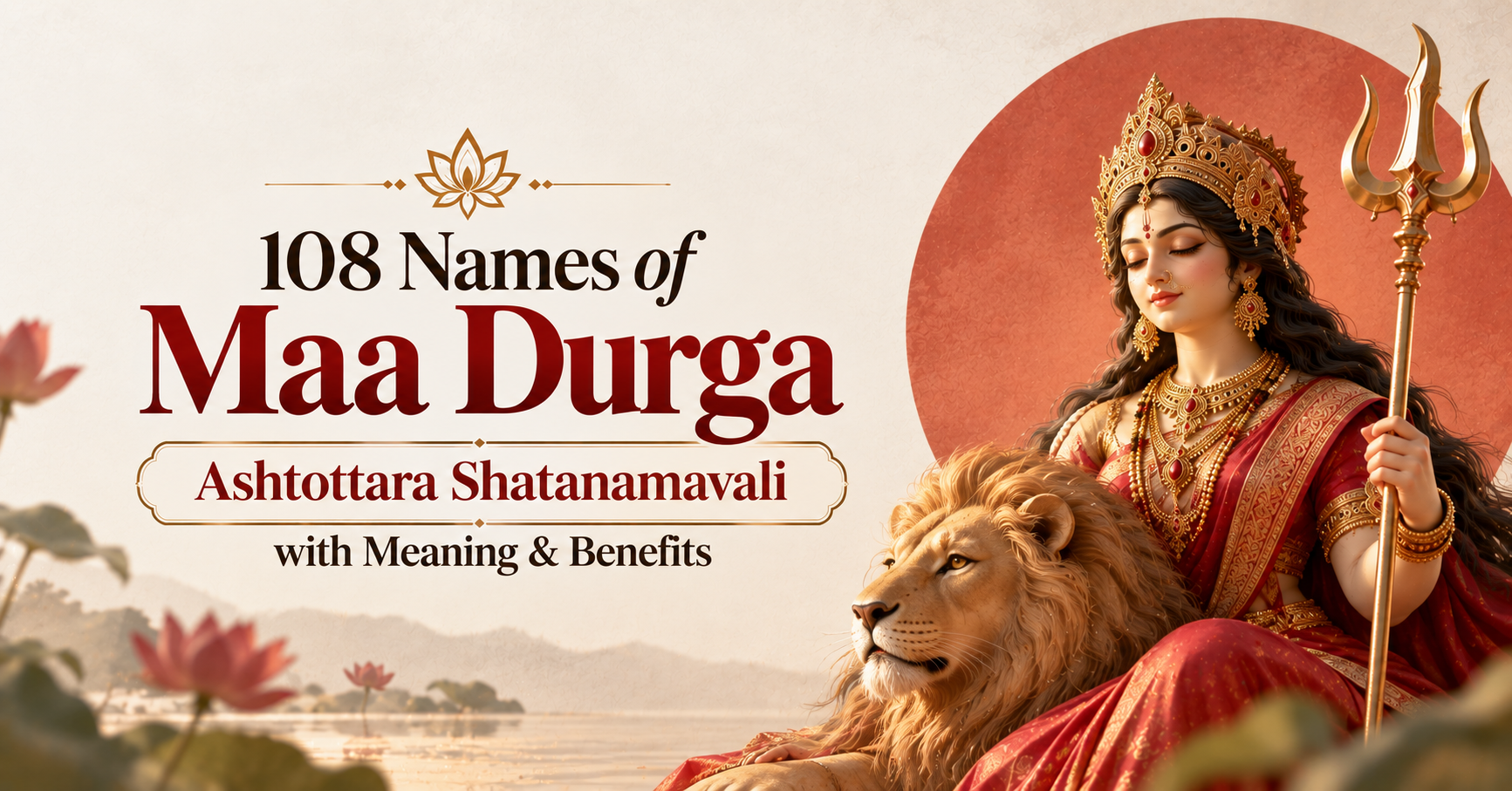
The 108 names of Durga are known as Durga Ashtottara Shatanamavali, a devotional list of 108 names that describe different qualities, forms and aspects of Maa Durga. Names such as Durga, Jaya, Bhavani, Chandraghanta and Kalaratri reflect her strength, compassion, wisdom and protective nature. Devotees recite these names during daily worship and especially during Navratri.
Why 108 Names?
The number 108 has a special place in Hindu spiritual practice. A traditional japa mala contains 108 beads, making the number closely associated with completing a full round of prayer or mantra repetition.
Reciting 108 names also allows devotees to remember different qualities and forms of the Goddess rather than focusing on only one aspect.
Where Do the 108 Names Come From?
The Durga Ashtottara Shatanama Stotram is traditionally associated with the Vishvasara Tantra. In the text, Lord Shiva tells Parvati that he will reveal 108 names of Durga. The names describe the Goddess through forms, qualities, powers and manifestations. Different traditional sources may present variations in spelling, transliteration or sequence.
108 Names of Durga in Hindi and English
If you are searching for 108 names of Durga in Hindi, 108 names of Durga in English, or Durga Maa ke 108 naam, the list below provides the complete 108-name sequence along with simple meanings.
Note: Different traditional versions of the Durga Ashtottara Shatanamavali may have minor variations in spelling, transliteration and interpretation. The list below follows the Vishvasara Tantra-associated version.
Names 1 to 27
| No. | Hindi Name | English Name | Meaning |
| 1 | सती | Sati | The virtuous Goddess |
| 2 | साध्वी | Sadhvi | The virtuous one |
| 3 | भवप्रीता | Bhavaprita | Beloved of the universe |
| 4 | भवानी | Bhavani | Mother of existence |
| 5 | भवमोचनी | Bhavamochani | Liberator from worldly bondage |
| 6 | आर्या | Arya | The noble one |
| 7 | दुर्गा | Durga | The invincible one |
| 8 | जया | Jaya | The victorious one |
| 9 | आद्या | Aadya | The primordial Goddess |
| 10 | त्रिनेत्रा | Trinetra | The three-eyed Goddess |
| 11 | शूलधारिणी | Shooldharini | Bearer of the trident |
| 12 | पिनाकधारिणी | Pinakadharini | Bearer of Shiva’s bow |
| 13 | चित्रा | Chitra | The beautiful and varied one |
| 14 | चण्डघण्टा | Chandraghanta | Goddess associated with the mighty bell |
| 15 | महातपा | Mahatapa | One of great austerity |
| 16 | मन | Mana | Embodiment of the mind |
| 17 | बुद्धि | Buddhi | Wisdom and intelligence |
| 18 | अहंकारा | Ahankara | The principle of individuality |
| 19 | चित्तरूपा | Chittarupa | Embodiment of consciousness |
| 20 | चिता | Chita | Associated with the funeral fire |
| 21 | चिति | Chiti | Consciousness |
| 22 | सर्वमन्त्रमयी | Sarvamantramayi | Embodiment of all mantras |
| 23 | सत्ता | Satta | Existence and being |
| 24 | सत्यानन्दस्वरूपिणी | Satyanandasvarupini | Embodiment of true bliss |
| 25 | अनन्ता | Ananta | Infinite and limitless |
| 26 | भाविनी | Bhavini | The creative and nurturing one |
| 27 | भाव्या | Bhavya | Worthy of contemplation |
Names 28 to 54
| No. | Hindi Name | English Name | Meaning |
| 28 | भव्या | Bhavya | Auspicious and glorious |
| 29 | अभव्या | Abhavya | Beyond ordinary grandeur |
| 30 | सदागति | Sadagati | Bestower of the highest path |
| 31 | शाम्भवी | Shambhavi | Beloved of Shambhu (Shiva) |
| 32 | देवमाता | Devamata | Mother of the divine |
| 33 | चिन्ता | Chinta | Associated with thought and contemplation |
| 34 | रत्नप्रिया | Ratnapriya | One who is fond of jewels |
| 35 | सर्वविद्या | Sarvavidya | Source of all knowledge |
| 36 | दक्षकन्या | Dakshakanya | Daughter of Daksha |
| 37 | दक्षयज्ञविनाशिनी | Dakshayajnavinashini | Destroyer of Daksha’s sacrifice |
| 38 | अपर्णा | Aparna | She who undertook severe austerities |
| 39 | अनेकवर्णा | Anekavarna | Of many forms and colours |
| 40 | पाटला | Patala | Reddish in appearance |
| 41 | पाटलावती | Patalavati | One associated with a red hue |
| 42 | पट्टाम्बरपरीधाना | Pattambaraparidhana | Clad in fine garments |
| 43 | कलमञ्जीररञ्जिनी | Kalamanjiraranjini | Adorned with melodious anklets |
| 44 | अमेयविक्रमा | Ameyavikrama | Of immeasurable courage |
| 45 | क्रूरा | Krura | Fierce toward evil |
| 46 | सुन्दरी | Sundari | The beautiful one |
| 47 | सुरसुन्दरी | Surasundari | Beautiful among the divine |
| 48 | वनदुर्गा | Vanadurga | Durga of the forests |
| 49 | मातङ्गी | Matangi | The Goddess Matangi |
| 50 | मतङ्गमुनिपूजिता | Matangamunipujita | Worshipped by Sage Matanga |
| 51 | ब्राह्मी | Brahmi | Divine feminine power of Brahma |
| 52 | माहेश्वरी | Maheshwari | Divine feminine power of Shiva |
| 53 | ऐन्द्री | Aindri | Divine feminine power of Indra |
| 54 | कौमारी | Kaumari | Divine feminine power of Kartikeya |
Names 55 to 81
| No. | Hindi Name | English Name | Meaning |
| 55 | वैष्णवी | Vaishnavi | Divine feminine power of Vishnu |
| 56 | चामुण्डा | Chamunda | Slayer of Chanda and Munda |
| 57 | वाराही | Varahi | Divine feminine power associated with Varaha |
| 58 | लक्ष्मी | Lakshmi | Goddess of prosperity |
| 59 | पुरुषाकृति | Purushakriti | One who can assume a masculine form |
| 60 | विमलोत्कर्षिणी | Vimalotkarshini | Pure and uplifting |
| 61 | ज्ञाना | Jnana | Knowledge |
| 62 | क्रिया | Kriya | Sacred action |
| 63 | नित्या | Nitya | The eternal one |
| 64 | बुद्धिदा | Buddhida | Bestower of wisdom |
| 65 | बहुला | Bahula | One of many forms |
| 66 | बहुलप्रेमा | Bahulaprema | Abundant in love |
| 67 | सर्ववाहनवाहना | Sarvavahanavahana | One who rides all vehicles |
| 68 | निशुम्भशुम्भहननी | Nishumbhashumbhahanani | Slayer of Shumbha and Nishumbha |
| 69 | महिषासुरमर्दिनी | Mahishasuramardini | Slayer of Mahishasura |
| 70 | मधुकैटभहन्त्री | Madhukaitabhahantri | Slayer of Madhu and Kaitabha |
| 71 | चण्डमुण्डविनाशिनी | Chandamundavinashini | Destroyer of Chanda and Munda |
| 72 | सर्वासुरविनाशा | Sarvasuravinasha | Destroyer of all demons |
| 73 | सर्वदानवघातिनी | Sarvadanavaghātini | Destroyer of demonic forces |
| 74 | सर्वशास्त्रमयी | Sarvashastramayi | Embodiment of sacred knowledge |
| 75 | सत्या | Satya | Truth itself |
| 76 | सर्वास्त्रधारिणी | Sarvastradharini | Bearer of all weapons |
| 77 | अनेकशस्त्रहस्ता | Aneka-shastrahasta | Holder of many weapons |
| 78 | अनेकास्त्रस्य धारिणी | Anekastradharini | Bearer of many divine weapons |
| 79 | कुमारी | Kumari | The youthful maiden |
| 80 | एककन्या | Ekakanya | The unique maiden |
| 81 | कैशोरी | Kaishori | The youthful Goddess |
Names 82 to 108
| No. | Hindi Name | English Name | Meaning |
| 82 | युवती | Yuvati | The youthful one |
| 83 | यति | Yati | The ascetic one |
| 84 | अप्रौढा | Apraudha | Ever youthful |
| 85 | प्रौढा | Praudha | The mature one |
| 86 | वृद्धमाता | Vriddhamata | The ancient Mother |
| 87 | बलप्रदा | Balaprada | Bestower of strength |
| 88 | महोदरी | Mahodari | One who contains the universe |
| 89 | मुक्तकेशी | Muktakeshi | The Goddess with flowing hair |
| 90 | घोररूपा | Ghorarupa | The fierce-formed one |
| 91 | महाबला | Mahabala | Possessed of immense strength |
| 92 | अग्निज्वाला | Agnijwala | Radiant like fire |
| 93 | रौद्रमुखी | Raudramukhi | The fierce-faced one |
| 94 | कालरात्रि | Kalaratri | The dark and powerful night form |
| 95 | तपस्विनी | Tapasvini | The ascetic Goddess |
| 96 | नारायणी | Narayani | Divine feminine power of Narayana |
| 97 | भद्रकाली | Bhadrakali | The auspicious and fierce Kali |
| 98 | विष्णुमाया | Vishnumaya | Divine power associated with Vishnu |
| 99 | जलोदरी | Jalodari | One who contains the cosmic waters |
| 100 | शिवदूती | Shivaduti | Messenger of Shiva |
| 101 | कराली | Karali | The fierce one |
| 102 | अनन्ता | Ananta | Infinite and limitless |
| 103 | परमेश्वरी | Parameshwari | Supreme Goddess |
| 104 | कात्यायनी | Katyayani | The form worshipped as Katyayani |
| 105 | सावित्री | Savitri | Divine feminine power of Savitr |
| 106 | प्रत्यक्ष | Pratyaksha | The directly manifest one |
| 107 | ब्रह्मवादिनी | Brahmavadini | Knower and speaker of the Divine |
| 108 | — | — | The 108-name sequence concludes with Brahmavadini |
Benefits of Chanting the 108 Names of Maa Durga
Devotees traditionally recite the 108 names as a way of remembering Maa Durga’s different qualities and forms. The spiritual benefits are understood through devotion rather than as guaranteed material or medical outcomes.
- Inner strength: The names remind devotees of Durga’s courage and protective nature.
- Calm and focus: Repetition can create a steady rhythm for prayer and contemplation.
- Devotional connection: Chanting helps devotees spend focused time in remembrance of Maa Durga.
- A sense of protection: Many devotees turn to Durga’s names when seeking spiritual strength and reassurance.
- Blessings and positive intention: Regular prayer can become a meaningful part of one’s spiritual routine.
How to Chant the 108 Names During Navratri
The Durga ke 108 naam can be included in a simple daily Navratri prayer routine. You do not need an elaborate setup. What matters most is a clean space, a focused mind and sincere devotion.
A simple routine is:
- Clean your prayer space and sit comfortably.
- Light a diya and, if you wish, offer flowers to Maa Durga.
- Take a moment to settle your mind before beginning.
- Recite the 108 names slowly and clearly.
- Complete one full round of the Namavali.
- Offer a short prayer and prasad after the recitation.
During the nine days of Navratri, devotees can complete one round of the 108 names each day, creating a simple nine-day devotional practice.
Best Time to Chant
The 108 names can be recited in the early morning, including Brahma Muhurta, or in the evening when the home is quiet and suitable for prayer. During Navratri, consistency is more important than choosing a complicated ritual time. Choose a time when you can recite the names peacefully without rushing.
For more on the nine-day celebration, read our guide to the nine nights of Navratri.
108 Names vs Durga Chalisa vs Durga Aarti
These three forms of Durga devotion are related but serve different purposes.
| Practice | What it is | Common use |
| 108 Names of Durga | A list of 108 names describing different qualities and forms of Maa Durga | Name chanting, japa and daily worship |
| Durga Chalisa | A 40-verse devotional hymn praising Maa Durga | Regular devotional recitation |
| Durga Aarti | A prayer traditionally sung with a lit diya during worship | Usually performed toward the end of puja |
If you want a longer devotional hymn, you can read our Durga Chalisa lyrics and meaning. For the ritual prayer, explore Durga Aarti lyrics.
You can also explore our collection of Navratri bhajans for devotional listening during the nine days.
Listen to Durga Bhajans and Mantras
Along with chanting the Maa Durga ke 108 naam, listening to devotional bhajans and mantras can become part of a daily prayer routine.
Soulful Bhajans bring together devotional music and spiritual content for moments of prayer, reflection and worship. Listen to Durga bhajans and mantras while preparing for puja, during quiet evening prayer or as part of your Navratri routine.
Explore more devotional content through our collection of Hindu deities and learn about the power of bhakti songs.
FAQs
What is the significance of the 108 names of Durga?
Each name highlights a different quality, form or aspect of Maa Durga. Reciting all 108 names allows devotees to remember the Goddess through many expressions, including strength, wisdom, compassion and protection. The number 108 itself also has longstanding spiritual significance in Hindu traditions and is associated with the 108-bead japa mala.
Why is Durga worshipped with 108 names?
Maa Durga is worshipped through 108 names because the Namavali brings together different qualities and manifestations of the Goddess. Instead of focusing on only one form, devotees can use each name as a point of remembrance, prayer and contemplation.
What is the best time to chant Durga’s 108 names?
The 108 names can be recited in the early morning or evening. Brahma Muhurta is traditionally considered a suitable time for spiritual practice, while evening prayer can be convenient for families. During Navratri, devotees may choose one consistent time each day and complete one round of the names.
Can chanting the 108 names help overcome obstacles?
Devotees traditionally believe that remembering Maa Durga through her names can provide courage, inner strength and spiritual reassurance when facing difficulties. These are matters of faith and devotion, so chanting should not be presented as a guaranteed solution to specific problems or as a substitute for practical help.
Where can I find the complete 108 names of Durga?
The complete 108 names of Durga are listed above in Hindi, English transliteration and simple meanings. The list is also known as Durga Ashtottara Shatanamavali. Because traditional recensions can vary, the Sanskrit/Hindi form should be checked against the chosen source when preparing a prayer book or printed devotional material.
What are Durga Maa ke 108 naam?
Durga Maa ke 108 naam are the sacred names traditionally recited as the Durga Ashtottara Shatanamavali. They include names such as Sati, Bhavani, Durga, Jaya, Trinetra, Chandraghanta, Mahishasuramardini, Kalaratri, Katyayani and Brahmavadini, each highlighting a different quality or form of the Goddess.
What are the 108 names of Durga for Navratri?
During Navratri, devotees can include the 108 names of Durga in their daily prayer routine by completing one round of the Namavali each day for nine days. You can begin with a diya and flowers, recite the names slowly, and end with a short prayer or prasad.
Are Durga’s 108 names different from the Durga Chalisa?
Yes. The 108 names are a Namavali, where each name invokes a quality or form of Maa Durga. The Durga Chalisa is a 40-verse devotional hymn. Both can be included in worship, but the structure and purpose of the two forms of prayer are different.
What are Mata Rani ke 108 naam?
Mata Rani ke 108 naam is another common way people search for the 108 sacred names of Maa Durga. The names in the Namavali describe different forms, qualities and powers of the Goddess and are commonly recited during puja, Navratri and other devotional occasions.